Saturday, March 19, 2011

Religious Conversion


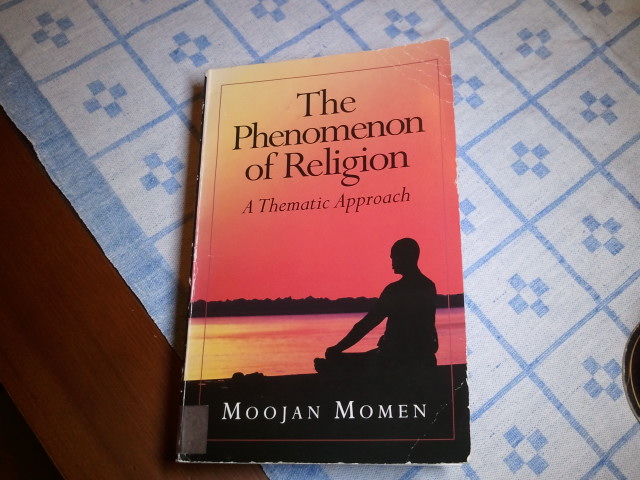
I'm still reading Moojan Momen's book The Phenomenon of Religion. A Thematic Approach (Oneworld Publications, 1999), and blogging about what I find interesting in the book. This time the issue is conversion. Here's how Momen describes the basic requirements for religious conversion to occur:

When a religious conversion occurs, whether this be in an individual conversion, the mass conversion of society or a religious reform, many of the same features arise. The first necessity is for a sense of dissatisfaction with the old religion. There must be important, 'toublesome' questions that the old religion is either unable to resolve or over which it cannot agree. [...]

An alternative religious viewpoint must be available which addresses these issues (or at least some of them) coherently and in an illuminating manner. [...] One important point of note is that there must be some degree of overlap between the old religious worldview and the new one. [...] A modern European is extremely unlikely to understand, let alone adopt, the religious worldview of a Papual head-hunter, but there is a considerable overlap between the Christian-based European worldview and those of communism, Islam or the Baha'i Faith.

Those who represent the old worldview, in particular the priests or the religous professionals of the established religion, will put up resistance to the new viewpoint. Among other measures, they will adapt the old worldview so as to make it more compatible with the new questions that have arisen [...].

Those who adopt the new religious worldview are, in effect, making a leap of faith. The change from one worldview to another cannot be solely justified on rational grounds, for each worldview is wholly consistent and coherent within itself.
(Pp. 152 - 153.)

This seems reasonable, for the most part. I'm especially glad that communism was counted as a religion here, for it certainly seems to be a religion to some (as are movements like veganism, the Zeitgeist Movement, and the ideology of the free market system).

There are only two squabbles I have with the above. First is that it doesn't necessarily apply to what is often called "deconversion", i.e. the discarding of religion without turning to a new one. But then I suppose this is just about the conversion from one religion to another, and "deconversion" can be dealt with elsewhere.

The second issue is somewhat more serious. It's the claim that all worldviews are internally consistent and coherent. I seriously doubt that is the case. The whole idea that conversion could never be rational, is highly suspicious. Here it may be that the writer's own religion (which is somewhat relativistic, AFAIK) may be influencing how work a little too much. Certainly it cannot be just assumed that all worldviews are consistent and coherent -- they must each be examined on a case by case basis.

Momen then analyzes the causes and requirements of conversion in more detail as follows:

MARGINALITY. Individuals who are at the margins of society (in terms of being connected to the sources of power or being involved in the culture) are more likely to convert to a new religion that is presented to them.

SOCIAL OR CULTURAL CRISIS. Individuals from cultures and societies that are in crisis are more likely to convert than those from stable cultures and societies. [...] A high degree of cultural and conceptual dissonance will inhibit conversion.

INDIVIDUAL CRISIS. Just as social and cultural crises serve to highlight the breakdown of the old order and lead to a search for a new basis for society, so an individual crisis may destroy the old framework of a person's life and open up the possibility of a new worldview. Apart from the usual personal crises in health, finances or family that individuals may experience, mystical experiences, intellectual doubts, leadership crises in their present religion, or dissatisfaction with life can all lead to individual crises that leave a person open to conversion. [...] Of course, both with individual crises and social and cultural crises, the new religion must offer some new vision or a means of interpreting the current situation that offers a better resolution of its problems than the existing religion.

INDIVIDUAL BACKGROUND. Research has shown that those who do convert to a new religion have a much greater likelihood of having had a long history of emotional problems in childhood, adolescence and in the period immediately before conversion (often resulting in problems in making relationships), when compared to those who remain within a religion.

KINSHIP AND FRIENDSHIP NETWORKS. Religious conversion is much more likely to occur within networks of families and friends. The conversion of a friend or relative whom one knows to be trustworthy opens on up to the possibility of converting oneself, especially if one observes a change for the better in that individual. [...] A close personal relationship helps the potential convert to feel accepted; it increases self-esteem and enables the potential convert to overcome conflicts and uncertainties that may block the path to conversion. Of course, those who have experienced emotional and social deprivation in their earlier years will be more attracted to the new religion by the formation of a close personal relationship with a member of the religion. It should be noted that just as frequently, kinship and friendship networks may be a constraint upon conversion. If the family and friends of a potential convert are strongly against the potential conversion, this may be a decisive factor in his or her withdrawal from the process.

CHARISMATIC ATTRACTION. Many converts report that what initially attracted them to a religious movement was the charisma of the leader of the group. The perceived power, energy, and authoritative exposition of the leader can be an important catalyst that opens a person up to the possibility of change.

ENCAPSULATION. I noted above that human beings are constrained in their choices by their background, their culture, family, friends, social roles and so on. [...]

Encapsulation may be of different kinds and degrees. [1.] Physical encapsulation may be achieved by removing a person from all contact with his or her normal daily life. This would usually be achieved by going to a remote location or a physically surrounded building such as a retreat. [2.] Social encapsulation means restricting the access of the potential converts to all normal social interactions. This may be achieved in some groups by filling up all free time with group activities. Christian missionaries usually insist on indigenous converts changing their names to Christian names and frequently even changing their style of dress, thus making the conversion public and, often, isolating the convert socially. [3.] Ideological encapsulation means the creation of a state of mind that resists consideration of alternative religious options. This may be achieved by teaching that the group's doctrines are the only pure and redeeming path and that the outside world is irredeemably evil and corrupt.
(Pp. 154 - 156.)

The above are mostly understandable and only somewhat problematic (for example the idea of following a charismatic leader makes me nauseous), but clearly the last one, encapsulation, is something questionable. It is obviously a technique use by various evil cultists to brainwash people into joining their cult or to remain in it. In other cases it might be used in a less obvious manner, for example as more subtle uses of the ideological encapsulation, but even then it is at least intellectually dishonest. So, encapsulation certainly looks like a harmful feature of religion that just has to go. I will never consider as acceptable a religion that utilizes it.

People often like to depict things like conversion rituals as something wholly good, but they should realize that they exist for reasons that might not be completely nice, when you think about them. This is what Momen writes about them:

The process of conversion is often sealed by a ritual, such as the Christian baptism or confirmation. This serves to give public testimony of the event that has occurred in the convert's life; it sets the boundary between the new and the old and it serves to burn the convert's bridges, thus making it less likely that the convert will return to his or her previous allegiance. [...]

[H]owever enthusiastic the convert may be, a considerable proportion of converts do leave the religion again.
(P. 156.)

Such rituals as baptism are actually used (besides whatever other meaning they might have, also) to bind the convert more strongly to the new religion (and the religious organization, and the religious group). This can be a form of encapsulation. In any case, it is nice to know that people who do convert, are likely to convert again, so perhaps they tend to be thinking individuals, seeking something real?

Although it is convetional to think of a conversion as being a complete rejection of the past and a turning to a new way of life, in fact there is rarely such a complete change. [...] Inevitably, each convert brings into the new religion something of his or her previous religion.
(P. 158.)

This is one reason for the evolution of religions. They don't remain unaltered, especially their everyday practise, which is most likley to change slightly with new converts bringing their own previous customs, values and opinions within the sphere of the new religion.

Moving on, Momen analyzes the experience of conversion as follows:

The experience of religious conversion is reported differently by different individuals. This experience is partly moulded by the expectations of what conversion will be like [...]. John Lofland and Normal Skonovd have described six patterns or motifs of religious conversion.

  1. INTELLECTUAL. This involves an intesive study of a religion, using books, lectures, television, the Internet and other media that involve little interpersonal contact. Social pressure is usually avoided and belief precedes participation in the community.
  2. MYSTICAL. The prototype of this is the 'Road to Damascus' experience. It occurs suddenly and dramatically and may be associated with dreams or visions.
  3. EXPERIMENTAL. This involves an active exploration of different religious options with the potential convert assessing whether a religion 'works' and what benefit it brings. This motif is gradually worked through over a long period of time and participation in the community precedes belief.
  4. AFFECTUAL. This involves the creation of a direct, personal bond with members of the religious group over a period of time, thus giving the potential convert the experience of being loved and nurtured.
  5. REVIVALIST. This is the type of conversion that occurs in a revivalist meeting. It uses crowd conformity and a high degree of emotional arousal to achieve the conversion.
  6. COERCIVE. This is the type of conversion that involves brainwashing, coercive persuasion and thought programming. Although many new religious movements are accused of using this method, it is, in fact, probably rare and is often reversed if the coercive pressures are removed.
(P. 158 - 159.)

Of these different experiences of conversion, I really accept only the first, intellectual conversion. I understand this as meaning rational conversion. It is also what should be (but isn't) the common type of "deconversion", i.e. the discarding of religions altogether.

Friday, March 18, 2011

Acquisition of Religious Belief


I'm still reading Moojan Momen's book The Phenomenon of Religion. A Thematic Approach (Oneworld Publications, 1999), and blogging about what I find interesting in the book. Momen outlines the following three phases of a child's acquisition of religion, based on Herbert Kelman's work:

  1. COMPLIANCE. Initially, a child learns certain religious beliefs and behaviour through a mixture of reward and punishment. [...]
  2. IDENTIFICATION. This way of acquiring beliefs, attitudes, and behaviour involves taking someone whom one admires and trying to be like that person as much as possible. [...]
  3. INTERNALIZATION. While identification involves conforming, in order to think and act like an admired person, internalization involves a process of transforming oneself so that new ways of thinking and acting become a part of one's personality and being. These new ways are thus valued for themselves and can exist independently of what others may say or do and independently of whether an admired person says or does them. Most religious people would say that a person's religion is not trie religion until it exists at this level within the individual.
(Pp. 145 - 146.)


Momen uses James Fowler's work (based in turn on the works of Piaget, Kohlberg, and Erikson) to distinguish "six stages of faith development that are considered to evolve out of the basic pre-stage of undifferentiated faith that is characteristic of the first two years of life" (p. 147):

  1. INTUITIVE-PROJECTIVE FAITH. This is characteristic of ages 3-7. The child's faith is fantasy-filled and imitative of parents and other significant adults. There are the beginnings of awareness of self-identity, death and sex, and of the taboos related to each.
  2. MYTHIC-LITERAL FAITH. This corresponds to Piaget's stage of concrete operations (ages 7-11). It is when the child appropriates the stories, beliefs, and practices of his of her faith community. [...] Interpretation is, however, concrete and literal rather than abstract and symbolic.
  3. SYNTHETIC-CONVENTIONAL FAITH. [Emerges around adolescence.] It is at this stage that deeply-held values and beliefs are established often by identifying with and internalizing those of authority figures and role models: a personal ideology evolves.
  4. INDIVIDUATIVE-REFLECTIVE FAITH. This stage, which may occur in young adulthood, involves the integration of the various roles and patterns that the adolescent has acquired. [...] In relation to faith, this involves a realization of the fact that one's own view is only one of many possible worldviews and a rejection of literal interpretations of narratives and myths learned in childhood. [...]
  5. CONJUNCTIVE FAITH. This stage, which may emerge in mid-life, involves a sensitivity to patterns of interrelatedness. Efforts are made to accept and unify apparent opposites. There is a re-examination of the symbols and myths of the faith community and the development of an appreciation of these as a source of non-logical insights. The dangers if this stage are the development of passivity, complacency and cynical withdrawal.
  6. UNIVERSALIZING FAITH. Rarely, individuals may reach the stage which involves an awareness of an ultimate environment that is inclusive of all being. These individuals incarnate the spirit of an inclusive and fulfilled human community. They not only free themselves from the social, political, economic and ideological shackles that bind humanity but they create this possibility for others. Theirs is a universal, affirming, transcendent viewpoint. Because of this, they are often regarded by social institutions, including those of their religion, as being subversive.
The surveys that have been done to assess Fowler's stages have shown that there is a definite movement through stages 1 and 2 and into 3 in the first two decades of life (probably due to cognitive maturation, as described by Piaget). The evidence beyond this gets somewhat weaker, with roughly equal numbers past the age of 20 being assigned to stages 3 and 4, while 5 is uncommon and stage 6 is rare. [...] Thus it may be that [...] Fowler has taken the different styles of faith that exist in the world and given these a hierarchical value based on his own liberal Protestant Christian background.
(P. 147 - 148.)

Momen writes about what might be termed the context of discovery and the context of justification of religious belief:

William James argued that, in practice, human beings choose a particular conception of the world on the basis of faith and only then do they look for arguments to support the conclusions that they have reached. The work of several writers from fields other than religion seems to support James's view by describing parallel processes in other fields of human activity. (P. 149.)

This is an important passage that I must return to at a later time. It is of great importance to the issue of rationality, another special interest of mine.

Faith and Belief (and Superstition)

Moojan Momen notes in his The Phenomenon of Religion. A Thematic Approach (Oneworld Publications, 1999) that despite many attempts to define religious faith, there is still no agreement on an adequate formulation of it that describes all aspects of faith. He attempts to clarify the matter by using a disctinction between 'immediate and intuitive' faith (or 'faith-in') and 'intellectual' faith (or 'belief-that'). (P. 141.)

'Faith-in' is the disposition to believe in something, or as having a particular, committed worldview. It is thus personal, an individual's commitment. It does not depend on doctrinal formulas and propositions. 'Belief-that' on the other hand "indicates a disposition to believe that a proposition is true; it is impersonal in the sense that it is independent of the person making it" (p. 141).

Momen analyses these concepts further, and I will compile the following quotes from his book. The quotes are not direct, because I want to edit them a bit.

First, 'faith-in':

Faith-in involves an element of trusting in the object of one's faith; it involves the feeling that the object of one's faith is in some way greater than oneself and is able to lead one to greater fulfilment and happiness; that one can trust it to act in a beneficent way.

The factor of trust leads naturally to the feeling of dependence one the object of faith; a feeling that one can, with confidence, rely on the object of one's faith.

Part of the faith-in relationship involves a sense of loyalty and faithfulness towards one's object of faith, together with confidence that this is reciprocated.

Faith-in involves a great sense of love towards the object one's faith and a feeling of being in turn loved.

One aspect of faith-in is the willingness to obey the instructions of the object of one's faith.

One aspect of faith is the feeling that one would be willing to sacrifice for the object of one's faith. There is also often the idea that the sacrifice is mutual, that the object of one's faith has already sacrificed for one.

Faith-in is accompanied by a feeling of certainty concerning the promises made in the scriptures, together with the disappearance of the feeling of doubt and meaninglessness.

The consequence of faith-in should be seen in the life of the individual. Faith-in leads to a focus and direction for one's life. It ats as an absolute standard for one's conduct.
(Pp. 142 - 143.)

Second, 'belief-that':

In belief-that, dependence is expressed in such doctrinal formulas as determinism (that all of one's circumstances and actions are already predetermined by God).

Most religions have a doctrinal formula that emphasizes the need for faithfulness and loyalty. This is often translated into doctrines of faithfulness and loyalty to the institutions of the religion and to the religious community. Laws relating to marriage and the bringing up of children often emphasize the need for this loyalty to the religion.

Love is often emphasized in credal formulas that refer to the mutual love between God and humanity.

Obedience is expressed in the religious requirement to carry out the details of ritual law or spiritual discipline. Any deviation from the laws and rules of the religion need repentance and expiation. This aspect of a belief is also usually extended to obedience to the institutions of the religion.

Sacrifice may be expressed at the simplest level in sacrifices of one's property and wealth to the object of one's faith; it may also be expressed as a state of detachment from material things. From the other perspective, the object of one's faith is considered to have sacrificed also.

The various creeds, doctrines and dogmas express the certainties of the religion.

The consequences of faith are expressed doctrinally as being born again, englightenment, transformation, the work of the Holy Spirit.
(Pp. 142 - 143.)

Momen then goes on to explain:

Thus we can see that religious experience produces a certain disposition in the individual -- faith-in. If the believer tries to express this faith-in, he or she can only do so in terms of concepts that are available to him or her -- this immediately then enters the real of belief-that. We may say that faith-in is analysed by theologians and [philosophers of religion] and piut into doctrinal formulas that seek to express it -- and so becomes belief-that. (P. 143.)

* * *

Momen also mentions in this context the issue of superstition (which is of special interest to me personally):

Magic and religion are not easily separable entities. Most religions have incorporated at least some magical elements, if not into the orthodox religion, then at least into the popular religion. Indeed, if we consider the miracles said to have been performed by the founder of the religion as magic, then almost all religions have what may be called magic even in their orthodox elements. (P. 144.)

I have nothing to add to that statement for the moment, except my endorsement. This is an issue I will no doubt visit again, as will Momen in his book.

Saturday, March 12, 2011

Pathways to Religious Experience

The title of this text is the title of Chapter 5 in Moojan Momen's book The Phenomenon of Religion. A Thematic Approach (Oneworld Publications, 1999). In that chapter he goes over the

[...] various pathways that attempt to recreate the central experience of religion in a systematic way in society. These then are the principal forms in which religiosity expresses itself in society. Since the religious experience gives one the feeling of salvation or liberation, these pathways to religious experience may be called pathways to salvation or liberation. (P.117.)

Copied here is a picture from the book (p. 118) that nicely illustrates the author's point:


At the center of the picture is the religious experience, surrounded by all the pathways that lead to it. Of course there are actually several different religious experiences, as has been discussed in my previous posting, and will become apparent later in this one as well. The fact that they are all considered, nonetheless, to be what all religions have in common, could be due to the author's religious (Baha'i) views. Even if that might be misleading in some way, I do find it (for now) a useful way to look at religions.

Below I have copied a table from the book (p. 121) analyzing the common features of each pathway. I hope the writing isn't too small - the picture is as big as I was able to upload here.


The rest of this text will be a digest of the book's information on these pathways.


Ritualism

Ritualism is usually based on theistic assumptions of the otherness of a God or god to whom praise and glorification are due. [...]

The typical religious attitude on this path is that of piety, love and devotion. There is both love and often some degree of awe or fear of the Deity or figure that is the object of the ritual or worship. [...] The typical religious experience of this path is of the regenerative type, confirming and commissioning.
(Pp. 119 - 120.)


Legalism

This path to salvation is characterized by the belief that the will of a deity has been revealed in the form of a Holy Law. This law determines most of one's actions in daily life. [...]

Legalism is [...] the result of two main impulses in religion. The first is a concern to maintain ritual purity in society. This ensures that the rituals of the religion can be performed in the manner decreed and so be pleasing to the Deity. The second, which is in a sense a correlate of the first, is to maintain the ethics and morals of the society, and thus to maintain the order and correct functioning of society. [...]

In this path of salvation, the religious professional is not, as with ritualism, one who has a mysterious power to transform the ritual act into a path for salvation; rather he [...] is the man of learning who knows the Holy Law. [...]

The religious attitude on this path is one of discipline and self-control. The believer must control his or her life so as to stay within the limits of the Law. [...]

Legalism is usually linked to some extent with ritualism. The Holy Law prescribes rituals that must be performed according to the Law. Religious experience on the legalistic pathways usually arises, therefore, out of the ritual that is performed -- often in the saying of a prayer. [...] [T]he sense of the sacred is evoked not just by the correct performance of the ritual but also by the fellowship of the believers gathered for the occasion. The religious experience on this pathway tends to be of the regenerative type, confirming or commissioning.
(Pp. 120, 122 - 123.)


Evangelism

In this group the emphasis is on the grace and beneficence of the Deity. Salvation is then usually a matter of faith that this grace will be extended to all who seek it with love and devotion. These groups will tend to emphasize a personal relationship with the Deity. [...]

The task of the religious professional in these groups is to make the personal relationship between the Deity and the believer seem real. [...]

The religious attitude of this group usually involves a 'puritanical' approach to the world. It is expected that one's life be lived according to a strict moral code. [...] Another aspect of the religious attitude of these groups is triumphalism, the belief that their religion will triumph in the end over all others. These are also features of fundamentalism, with which evangelism is closely linked. [...] The main religious experience of this pathway to salvation is often of the charismatic type that is brought on by the preaching of the evangelist. Sings of this include ecstatic trance, speaking in tongues, and the otehr phenomena described above. There may also be regenerative religious experiences of the conversion type.
(Pp. 123, 125.)


Social Reformism

Social reformism goes out into the world and seeks to transform it into an ideal society. This pathway has historically been mainly that of the theistic religions. [...]

The religious attitude in this pathway is an outward-looking one that expresses itself in service and shows love and charity towards all, in particular the poor and disadvantaged. The source of religious experience on this pathway is the feeling of unity and fellowship with others who are imbued with similar ideals. Some may have a commissioning type of regenerative religious experience on this pathway.
(Pp. 126, 129.)


Ascetism

Some of those who see the world as the source of evil and corruption have considered that the best means of achieving salvation is to isolate oneself as far as possible from the world. This is often linked to disciplining the body severely, to reduce its dependence on the physical world. [...]

The religious attitude of those who follow this pathway is one of detachment from the world. They put themselves outside the social world in which other human beings participate; they become outside observers. The main source of religious experience in this pathway is the reading of the scriptures, prayer, fasting, and the other austerities that the ascetic undertakes. The ascetic may have any of the types of religious experience, but typically the mystical or charismatic.
(Pp. 129 - 130.)


Monasticism

The monastic community provides the opportunity to concentrate on the religious life for those who see no way of doing this in the outside world. [...]

The religious attitude in monasticism is towards an inward-turning detachment from the world. The source of religious experience is reading from the scripture, prayer, fasting and sometimes some austerities. There may, in some monastic communities, be a religious experience from the sense of community and fellowship. The main types of religious experience on this pathway are the mystical or the confirming type of regenerative experience.
(Pp. 131 - 132.)


Gnosticism

The principal idea of the gnostic movements is that the central religious experience is linked to a special knowledge to which only a select few have access. The knowledge usually takes the form of an inner (esoteric) understanding of either the scriptures or the rituals of the religion. [...]

One of the features of this tendency in the West is its eclectic nature. Consequently, many gnostic groups in the West have little connection with Christianity, for example New Thought, the Rosicrucians and Scientology. The approach that has become known as the Perennial Philosophy can also be classed as gnostic.

The principal religious attitude on this pathway involves a search for truth. This search is principally intellectual, a struggle to understand; some would say that it is also élitist. Part of the religious attitude must also be that of obedience to one's spiritual master, particularly in the early stages of the path. [...] The main source of religious experience is the scriptures; it occurs when there is an intellectual enlightenment regarding the true meaning of the scripture. The gnostic pathway is closely linked to mysticism. Many gnostic pathways use the experiential dimension of mysticism, including meditation or chanting, which helps to achieve altered states of consciousness.
(Pp. 132, 134 - 135.)


Mysticism

The term 'mysticism' is used to describe a wide variety of religious phenomena. For lack of a more suitable word, I shall use it to refer to those groups that consider that the central religious experience can best be recreated through achieving altered states of consciousness. Such states can be reached in two different ways. The first is the path of increased psychological arousal achieved, for example, by rhythmical chanting or dancing. This culminates in mystical ecstacy [...]. The second is the path of decreased mental activity leading to a deep state of meditation [...]. Both paths lead finally to a trance state. [...]

This type of religious experience, which can be found in both Eastern and Western religions, is usually closely linked to gnosticism. [...]

The trance-like state achieved by Western mystics is often described as filled with vivid visions and auditions. [...] The trance-like state of the Eastern mystic, however, is usually formless, visionless experience. [...] Western religion is predominantly devotional in nature, and so the product of the trance-like state is a vision of either the object of devotion or something closely associated with it. Eastern religion is predominantly oriented towards achieving an abstract notion - insight. The trance-like state therefore tends to be empty and formless. The main method of achieving altered states of consciousness is also different in the two forms of mysticism. It is achieved by increasing levels of mental arousal through chanting and similar activity in the Western religions, and decreasing levels through meditation in the Eastern religion. This may also have a bearing on the content of the trance.

The religious attitude on this pathway is one that tends to be turned inwards, trying to obtain a direct personal experience of the sacred. Once it is felt that this has been attained, then there is usually a feeling of love and compassion, not just towards other individual human beings, but more expansively, towards the whole cosmos. The main source of religious experience on this pathway is in the achievement of altered states of consciousness by such methods as chanting and meditation. The religious experience on this pathway is of the mystical type.
(Pp. 135 - 137.)


Classification of Religious Groups

The above are the different pathways to religious experience as classified and described by Moojan Momen. There is some overlap between these pathways, and a religious group may exhibit the use of more than one of them. Momen also classifies religious groups according to their utilisation of the pathways as follows.

Some religious groups only exhibit one of these methods of social expression (or possibly two interlinked methods). Therefore their appeal will be to only a narrow range of psychological types from among the general population. We may name these groups 'sects' or 'cults'. [...] In general, the word 'sect' applies to those groups that are more tightly organized and where beliefs are more narrowly defined (that is, they are epistemologically authoritarian); the word 'cult' to the more loosely organized groups where there is not such a strict insistence on adherence to particular beliefs.

On the other hand, any religion that would claim to be a 'world religion' should included all the different forms of religious expression and thus, potentially, be able to appeal to all types of people. [...]

An approach incorporating more than one, but not all, social expressions can be found in intermediate groupings that we might call 'churches' or 'denominations'. [...]

As well as catering for all types of social religoius expression, a world religion must also appeal to all types of individuals at the conceptual level, by its ability to encompass both the theistic and monistic viewpoints. A sect will usually only appeal either to the theistic or to the monistic viewpoint.
(Pp. 138 - 139.)


I was going to make several comments along the way, but this is too long as it is. No doubt I will return to those individual points I wanted to comment on in later posts.

Friday, March 11, 2011

Features of a Religious Experience

This text mostly consists of quotes from Moojan Momen's book The Phenomenon of Religion. A Thematic Approach, published by Oneworld Publications, 1999.

According to the book's author, there are three features that "apply to phenomenon of religious experience":

  1. UNIVERSALITY. Numerous surveys have consistently shown that even in the highly secularized societies of North America and Europe, a large proportion of the population have had what they describe as religious experiences. The proportion approaches one hundred per cent in traditional societies.
  2. DIVERSITY. Religious experience is unique for each individual. Religions may attempt to impose a uniformity of doctrine or of action upon their followers, but each person's religious experiences, when taken as a whole, will be different to those of another person.
  3. IMPORTANCE. Religious experience is almost invariably very important to the individual to whom it occurs, in a way that other experiences usually are not. A religious experience can result in change in the way that individuals think about themselves, a complete alteration of lifestyle, or a reorganization of the individual's conceptual world. (P. 88.)

I wonder if the secularized society in North America, alluded to in point 1, is Canada?

For someone (like me) who has never had a religious experience, it is difficult to imagine what is being talked about by those who claim to have had it. It is noteworthy that the experience is extremely common in "traditional societies", and less so in modern "Western" societies. It would be interesting to know why it is not so common here anymore. Has it become unnecessary for many of us secular Westerners? What then has taken its place?

Momen lists general features of the experience of the holy, another concept very important to religions, and closely connected to religious experiences:

  1. It is a very intense, energizing experience. It feels important and demands respect and attention.
  2. It is a liberating experience, in that it seems to free on from the demands of the physical world (but, in some, it may induce a sense of dependence on an 'other reality').
  3. It brings peace, joy, exultation, even exhiliration, although this can, on occasions, be mingled with awe and even dread. Some may even report the feeling of being possessed by a spiritual power.
  4. It seems to give on e a feeling of having achieved insight or knowledge, although it is often difficult to specify the content of this knowledge (it is ineffable, incapable of being adequately expressed in words). It is often described as 'confirming', in the sense of giving one the assurance that one's faith is true.
  5. Time may appear to stop and space may seem to become distorted. It may seem that the experience occurs 'outside' time and space.
  6. Many would say that for an experience to be truly religious, it should involve the whole person, lead to some element of personal transformation and result in some outward manifestation of the change in terms of action. Some may report a feeling of having been summoned to a mission through this experience. (Pp. 88 - 89.)

It is important to remember that there are many kinds of religious experiences even to the same individual. Momen speaks of this spectrum:

I have attempted to formulate these descriptions so as to include all levels of religious experience. Many of these descriptions have been attributed to mysticism and states of deep meditation, but I would maintain that it is more useful to see the mystical and meditative experience as being at one extreme of continuum of religious experience and activity. At the other end of this spectrum are the mundane tasks of the religious life, such as arranging the flowers in the church or sweeping out the Hindu temple. As one goes from one extreme to the other, the intensity and frequency of the experience may change, but all the above features may occur at any point in the continuum.

The Experience of the holy is the core of religion and its initiating and driving force. (P. 92.)

Momen analyses types of religious experience.

I. The first is The Regenerative Experience. It is subdivided thusly:

  1. CONVERSION EXPERIENCE. For many people, the experience takes the form of a conversion, leading them to align themselves to a religious movement to which they have not previously been aligned, because they experience the truth of that movement.
  2. CONFIRMING EXPERIENCE. For others, the experience regenerates their faith within a religious movement to which they already belong; the 'born'again' experience in Christianity and religious revivalism in Islam are two common examples.
  3. COMMISSIONING EXPERIENCE. This experience may be in the form of a 'call', a divine commission to carry out some action or take up a new way of life.

II. The second type of religious experience Momen explains is The Charismatic Experience.

This experience makes those involved feel that a gift has been bestowed upon them. This gift may include a feeling of being in a 'wider life than that of this world's selfish interests', a sense of being in continuity with the powers of the universe, and a sense of elation and joy as the sense of self and attachment to this world is abandoned. There is inner equilibrium and calm. It has been described as the experience of saintliness.

Typical this 'gift' gives its recipient the ability to heal, drive out evil spirits, speak in tongues, and perform other miracles and wonders. The receipt of this 'gift' is often marked by trance or ecstacy. (P. 94.)

III. The third type is The Mystical Experience.

This experience is characterized by James as being ineffable (impossible to describe in words), noetic (giving insight and knowledge that feels authoritative), transient (it cannot be sustained for long) and passive (although certain steps may be taken to induce the experience, it then takes over and possesses the person). (Pp. 95 - 96.)

IIII. Finally, Momen also mentions The Paranormal Experience (p. 97) as frequently associated with religious experiences in (at least some) Eastern Religions. He doesn't mention stigmatism, and other alleged paranormal phenomena connected to Christianity, but it's obvious that these things are important to some in the West as well.

Momen states that "very often the precursor to an intense religious experience [...] is a religious crisis. [...] A religious crisis is usually a period of existential doubt; a questioning of one's cognitive structures; a loss of confidence in one's interpretation of the world." (P. 98.) According to him, "there are three possible outcomes to such a crisis":

  1. A RESOLUTION WITHIN CURRENT COGNITIVE STRUCTURES. The person in crisis may eventually be able to resolve the crisis within his or her existing cognitive structures. This may be done by delving more deeply into the scriptures of one's religion and finding an answer there. Alternatively, discussion with one's fellow-believers may result in a solution being found. This may then be reported as a confirming religious experience.
  2. A CREATIVE RESPONSE, CHANGE TO A NEW COGNITIVE STRUCTURE. The inner struggle may reach the point at which the existing cognitive structures dissolve. Since our cognitive structures define reality for us, some report it as a dissolution of reality. At this point, thre religious person often reports a sense of surendering the self (giving up one's existing cognitive structures, which define one's self). Following this surrender, a new vision may emerge, a new way of looking at the questions, a new self, a new cognitie structure, the basis for a new reality. This may be reported as a confirming or conversion experience, but will usually be more intense than the first outcome.
  3. A PATHOLOGICAL RESPONSE, COGNITIVE DISSONANCE. Some react to the threatened breakup of their reality by retreating into denial of the problems that caused the crisis. In effect, they build up a fantasy world in which they create a reality that accords with their cognitive structures. This type of process is usually unstable and eventually breaks down, as such a response negatively affects the way that such people function in society. The process can usually only be stabilized by individuals either retreating from society or finding social support for this pathological response. (Pp. 98 - 99.)

Later, Momen writes about how people in the West tend to think of religious experience as a private affair, while for the rest of the world it usually occurs communally, and how the sense if unity and fellowship amongs the community can itself be a religious experience (pp. 109 - 110).

Momen then moves on to the social influence of religious experience. He notes the obvious fact that "religious experiences tend to conform closely to cultural and religious expectations".

Thus it would appear that religious experiences, no matter how intense and all-consuming, are subject to contraint by the cultural and religious normas of the person to whom they occur. Another way of looking at this is to say that there can be no such thing as a pure experience. An experience always happens to a person, and that person already has an interpretative framework through which he or she views the world. [...]

The most basic interpretative framework is language. We do not have an experience and then find words to describe it. Our language prefigures our experience of the world.

[...] We may think that we are free to choose whatever religious style of life we like, but in fact we are very unlikely to choose some and very likely to choose others, because of our background. (Pp. 114 - 115.)

This should be enough of an introduction to religious experiences in the abstract. What I am left wondering is could there be, or is there even in actuality, a non-religious equivalent for the religious experience? Also, is religious experience among the necessary criteria of something qualifying as a religion? If no follower of a movement claims to have had such an experience, do we have to call the movement something other than religion, even if it fulfills other criteria of religion?

Sunday, March 6, 2011

Eastern and Western religions

Moojan Moomen defines two types of religion in his book The Phenomenon of Religion. A Thematic Approach (Oneworld Publications, 1999) as follows:

I use the term 'Western religion' to refer to the mainstream orthodoxies of the Judaeo-Christian-Muslim group of religions. 'Eatern religion' refers to Buddhism, Taoism and Hinduism, especially of the Advaita Vedanta school. This division is useful in that these two groups of religions hold very differing and even contaradictory vies on the nature of the Ultimate Reality and of humanity's relationship to it.
[...]
Regarding the difference with the Eatern religions, the most important point is that in the Western religions those characteristics mentioned above, such as anger and kindness, all make God appear to have a personality, to act as a person. An impersonal entity would not have such characteristics.

In contrast, the Eastern religions, Buddhism, Taoism and Hinduism of the Advaita school, have no concept of God as a person; rather their concept is of Ultimate Reality as a process, a truth, or a state of being. This is usually stated as a concept of an Absolute Reality. The phrase 'Absolute Reality' implies that there is a single Reality in the cosmos; everything else that may appear real has only a relative or a contingent reality or is illusory or non-existent. The Absolute is therefore both transcendent and immanent. (P. 31 - 33.)

This bit about God (or gods) being a person is important and worth repeating. It makes little sense talking about a god in any other way, although apparently the word has been used in a more poetic ways (by Albert Einstein, for example), to refer to something like the God of pantheism. Such talk is only misleading and confusing, and will end up being used by theists in an attempt to support their claims. It clearly also makes no sense to pray to a god that is impersonal, while it does make sense to try to connect with such an entity somehow -- assuming of course that one already believes in the existence of such a god.

It also makes sense to seek enlightenment if one believes in the illusoriness of the sensible universe. It is no wonder that belief in paranormal powers goes with such a worldview as well. In Eastern religion, these alleged powers would be clearly magical, derived from the thaumaturgist herself, while in Western religion the power would be from God, and miracles not controlled but only asked for by the believer. Clearly, it is easy for belief systems to incorporate some from both views, as seems (IMHO) to have been done by (some) renaissance "mages".

We can call the view held by many Eastern religions that there is only one fundamental reality in the world, 'monism'. And by contrast, we can call the Western view that God and humanity form two distinct and separate realities, 'dualism'. Alternative names for the two systems would be 'absolutism' and 'theism' respectively. (P. 34.)

One type of religion is perhaps monistic, in the sense that there is only one reality, and the illusion we experience as reality is actually not real, and the other accepts the reality of two categories of entities -- one being everything in the material world, and the other usually being made of just one God; although the latter might comprise all sorts of entities made of spiritual substance. Nevertheless, both do seem transcendental in the sense that followers of both religions are oriented toward the (alleged) transcendent reality, whether it is the Absolute Reality, or the One God (or even just a more vague "hereafter"). This is the usual emphasis of relgion, caused no doubt by the fact that everyone can see (and has always been able to see) that this material world we live in is fundamentally evil, full of suffering and pain, and in many ways displeasing especially to us humans. Because we are naturally fair-minded, humans have decided that there must be some other world or level of reality that will balance this evil.

It is then curious that some Eastern religions, much like the philosophical schools of the Hellenistic period, seem to have also allowed for the possibility of reaching the transcendental goal in this life:

In Hinduism, the final goal is liberation (moksha or mukti). This state may be achieved in life, in which case it is called jivanmukti. Such a person is described as having achieved a state of existence-consciousness-bliss (sat-chit-ananda). For Buddhists, the final goal is the state of Nirvana (which means 'blown out'). This state is characterized by the extinction of all craving and desires, a complete detachment from the world. (P. 35.)

In Western religions, only some saints, mystics, and monks have attempted to reach for the final goal within their lives, and even they have (if I am not mistaken) always believed it to be impossible to completely reach it during their lives. They could perhaps experience Union with God briefly (albeit ecstatically), but only after their deaths would they actually get to meet their maker.

The idea of a living holy man who has reached the heights of illumination of course has the unfortunate effect of making people gullible and thus vulnerable to all sorts of hoaxers and charlatans. One would think that the Rationalists of India will be kept busy as a result, for quite a long time to come.

Thursday, March 3, 2011

Thematically about religion

I started reading The Phenomenon of Religion. A Thematic Approach by Moojan Momen, published by Oneworld Publications, 1999. It seems interesting, but there are questionable passages already in the beginning.

The first (pp. 24 - 25) is a claim about religion even in the West not being seen as an individual choice until the rise of Protestantism (it was an important part of Islam before that). If this is taken only to be saying that the surrounding communities did not (usually) allow its members to make individual decisions, then that is a fairly obvious point. But surely it was understood even before the Middle Ages that individuals could and did convert on their own, contrary to social norms. In Medieval times heretical individuals were even hunted by Inquisitors. Usually, I accept, it was whole communities that converted at once, but the existence of individuals who think differently was known.

The author acknowledges in the beginning of the book that his attitude toward religion is broadly sympathetic (p. 3), and according to his homepage he is a Baha'i. I have no problem with that, but I do have a problem with someone presenting religions in general as something good, as opposed to the lack of religion. This is what Momen seems to be doing in the second questionable passage that I've already come across. It is a list comparing worldly values and religious values (p. 29). Among worldly values are listed things like "revel in self-glory" (and others much worse, even amusingly the claim that the worldly "are rigid and self-opinionated", while the religious "are flexible in thinking"). Now, I can understand that this is how the religious believer may think that this is the case, it is not what I would expect to see in an academic work on "religious studies".

I can only hope the rest of the book is of better quality.

I did encounter something better already, about the definitions of religion. Momen lists (p. 27) the following aspects of religion as something definitions of religion have to try to cover:


  • The first, at the individual level, is religious experience. It is what was described at the beginning of this chapter, as bbeing the experience of the 'holy' or the 'sacred'. It is the personal, experiential aspect of religion.
  • The second, at the conceptual level, is the universal idea that there is some Ultimate Reality, and that the most important activity for human beings is to establish and clarify their relationshup with this Reality. This is the conceptual and doctrinal aspect of religion.
  • The third, at the social level, is the fact that all religions are to a greater or lesser extent involved in creating social cohesion and the integration of the individual into society. All of them have created some form of social and institutional order. From this, the ethical and social aspect of religion is derived.

In this book Momen uses a concept of religion that "relates it to a concept of the supernatural or supra-human (or perhaps even supra-scientific), rather than the wider functional definition that would include such secular ideologies as Marxism and nationalism" (p. 28). As he makes the choice while being aware of this problem, it is acceptable. Less clear is whether the reader should accept his intention of distinguishing religion from magic. He notes that they "commonly coalesce and interpenetrate" (p. 28), but will not go deeper into this question at this early point.

I will continue reading the book, possibly commenting on it again in separate posts.