Saturday, March 12, 2011

Pathways to Religious Experience

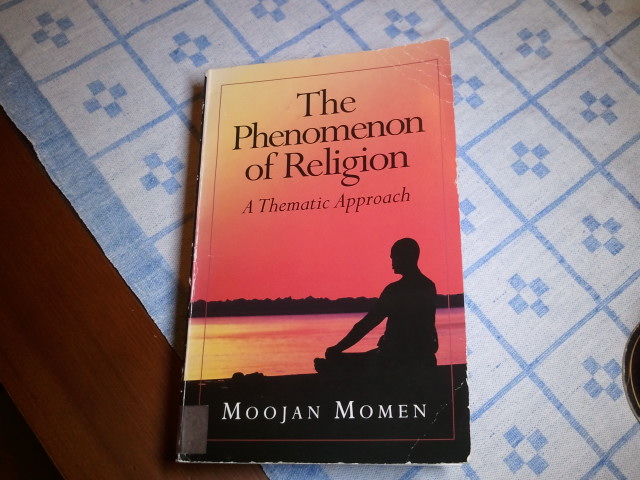
The title of this text is the title of Chapter 5 in Moojan Momen's book The Phenomenon of Religion. A Thematic Approach (Oneworld Publications, 1999). In that chapter he goes over the

[...] various pathways that attempt to recreate the central experience of religion in a systematic way in society. These then are the principal forms in which religiosity expresses itself in society. Since the religious experience gives one the feeling of salvation or liberation, these pathways to religious experience may be called pathways to salvation or liberation. (P.117.)

Copied here is a picture from the book (p. 118) that nicely illustrates the author's point:


At the center of the picture is the religious experience, surrounded by all the pathways that lead to it. Of course there are actually several different religious experiences, as has been discussed in my previous posting, and will become apparent later in this one as well. The fact that they are all considered, nonetheless, to be what all religions have in common, could be due to the author's religious (Baha'i) views. Even if that might be misleading in some way, I do find it (for now) a useful way to look at religions.

Below I have copied a table from the book (p. 121) analyzing the common features of each pathway. I hope the writing isn't too small - the picture is as big as I was able to upload here.


The rest of this text will be a digest of the book's information on these pathways.


Ritualism

Ritualism is usually based on theistic assumptions of the otherness of a God or god to whom praise and glorification are due. [...]

The typical religious attitude on this path is that of piety, love and devotion. There is both love and often some degree of awe or fear of the Deity or figure that is the object of the ritual or worship. [...] The typical religious experience of this path is of the regenerative type, confirming and commissioning.
(Pp. 119 - 120.)


Legalism

This path to salvation is characterized by the belief that the will of a deity has been revealed in the form of a Holy Law. This law determines most of one's actions in daily life. [...]

Legalism is [...] the result of two main impulses in religion. The first is a concern to maintain ritual purity in society. This ensures that the rituals of the religion can be performed in the manner decreed and so be pleasing to the Deity. The second, which is in a sense a correlate of the first, is to maintain the ethics and morals of the society, and thus to maintain the order and correct functioning of society. [...]

In this path of salvation, the religious professional is not, as with ritualism, one who has a mysterious power to transform the ritual act into a path for salvation; rather he [...] is the man of learning who knows the Holy Law. [...]

The religious attitude on this path is one of discipline and self-control. The believer must control his or her life so as to stay within the limits of the Law. [...]

Legalism is usually linked to some extent with ritualism. The Holy Law prescribes rituals that must be performed according to the Law. Religious experience on the legalistic pathways usually arises, therefore, out of the ritual that is performed -- often in the saying of a prayer. [...] [T]he sense of the sacred is evoked not just by the correct performance of the ritual but also by the fellowship of the believers gathered for the occasion. The religious experience on this pathway tends to be of the regenerative type, confirming or commissioning.
(Pp. 120, 122 - 123.)


Evangelism

In this group the emphasis is on the grace and beneficence of the Deity. Salvation is then usually a matter of faith that this grace will be extended to all who seek it with love and devotion. These groups will tend to emphasize a personal relationship with the Deity. [...]

The task of the religious professional in these groups is to make the personal relationship between the Deity and the believer seem real. [...]

The religious attitude of this group usually involves a 'puritanical' approach to the world. It is expected that one's life be lived according to a strict moral code. [...] Another aspect of the religious attitude of these groups is triumphalism, the belief that their religion will triumph in the end over all others. These are also features of fundamentalism, with which evangelism is closely linked. [...] The main religious experience of this pathway to salvation is often of the charismatic type that is brought on by the preaching of the evangelist. Sings of this include ecstatic trance, speaking in tongues, and the otehr phenomena described above. There may also be regenerative religious experiences of the conversion type.
(Pp. 123, 125.)


Social Reformism

Social reformism goes out into the world and seeks to transform it into an ideal society. This pathway has historically been mainly that of the theistic religions. [...]

The religious attitude in this pathway is an outward-looking one that expresses itself in service and shows love and charity towards all, in particular the poor and disadvantaged. The source of religious experience on this pathway is the feeling of unity and fellowship with others who are imbued with similar ideals. Some may have a commissioning type of regenerative religious experience on this pathway.
(Pp. 126, 129.)


Ascetism

Some of those who see the world as the source of evil and corruption have considered that the best means of achieving salvation is to isolate oneself as far as possible from the world. This is often linked to disciplining the body severely, to reduce its dependence on the physical world. [...]

The religious attitude of those who follow this pathway is one of detachment from the world. They put themselves outside the social world in which other human beings participate; they become outside observers. The main source of religious experience in this pathway is the reading of the scriptures, prayer, fasting, and the other austerities that the ascetic undertakes. The ascetic may have any of the types of religious experience, but typically the mystical or charismatic.
(Pp. 129 - 130.)


Monasticism

The monastic community provides the opportunity to concentrate on the religious life for those who see no way of doing this in the outside world. [...]

The religious attitude in monasticism is towards an inward-turning detachment from the world. The source of religious experience is reading from the scripture, prayer, fasting and sometimes some austerities. There may, in some monastic communities, be a religious experience from the sense of community and fellowship. The main types of religious experience on this pathway are the mystical or the confirming type of regenerative experience.
(Pp. 131 - 132.)


Gnosticism

The principal idea of the gnostic movements is that the central religious experience is linked to a special knowledge to which only a select few have access. The knowledge usually takes the form of an inner (esoteric) understanding of either the scriptures or the rituals of the religion. [...]

One of the features of this tendency in the West is its eclectic nature. Consequently, many gnostic groups in the West have little connection with Christianity, for example New Thought, the Rosicrucians and Scientology. The approach that has become known as the Perennial Philosophy can also be classed as gnostic.

The principal religious attitude on this pathway involves a search for truth. This search is principally intellectual, a struggle to understand; some would say that it is also élitist. Part of the religious attitude must also be that of obedience to one's spiritual master, particularly in the early stages of the path. [...] The main source of religious experience is the scriptures; it occurs when there is an intellectual enlightenment regarding the true meaning of the scripture. The gnostic pathway is closely linked to mysticism. Many gnostic pathways use the experiential dimension of mysticism, including meditation or chanting, which helps to achieve altered states of consciousness.
(Pp. 132, 134 - 135.)


Mysticism

The term 'mysticism' is used to describe a wide variety of religious phenomena. For lack of a more suitable word, I shall use it to refer to those groups that consider that the central religious experience can best be recreated through achieving altered states of consciousness. Such states can be reached in two different ways. The first is the path of increased psychological arousal achieved, for example, by rhythmical chanting or dancing. This culminates in mystical ecstacy [...]. The second is the path of decreased mental activity leading to a deep state of meditation [...]. Both paths lead finally to a trance state. [...]

This type of religious experience, which can be found in both Eastern and Western religions, is usually closely linked to gnosticism. [...]

The trance-like state achieved by Western mystics is often described as filled with vivid visions and auditions. [...] The trance-like state of the Eastern mystic, however, is usually formless, visionless experience. [...] Western religion is predominantly devotional in nature, and so the product of the trance-like state is a vision of either the object of devotion or something closely associated with it. Eastern religion is predominantly oriented towards achieving an abstract notion - insight. The trance-like state therefore tends to be empty and formless. The main method of achieving altered states of consciousness is also different in the two forms of mysticism. It is achieved by increasing levels of mental arousal through chanting and similar activity in the Western religions, and decreasing levels through meditation in the Eastern religion. This may also have a bearing on the content of the trance.

The religious attitude on this pathway is one that tends to be turned inwards, trying to obtain a direct personal experience of the sacred. Once it is felt that this has been attained, then there is usually a feeling of love and compassion, not just towards other individual human beings, but more expansively, towards the whole cosmos. The main source of religious experience on this pathway is in the achievement of altered states of consciousness by such methods as chanting and meditation. The religious experience on this pathway is of the mystical type.
(Pp. 135 - 137.)


Classification of Religious Groups

The above are the different pathways to religious experience as classified and described by Moojan Momen. There is some overlap between these pathways, and a religious group may exhibit the use of more than one of them. Momen also classifies religious groups according to their utilisation of the pathways as follows.

Some religious groups only exhibit one of these methods of social expression (or possibly two interlinked methods). Therefore their appeal will be to only a narrow range of psychological types from among the general population. We may name these groups 'sects' or 'cults'. [...] In general, the word 'sect' applies to those groups that are more tightly organized and where beliefs are more narrowly defined (that is, they are epistemologically authoritarian); the word 'cult' to the more loosely organized groups where there is not such a strict insistence on adherence to particular beliefs.

On the other hand, any religion that would claim to be a 'world religion' should included all the different forms of religious expression and thus, potentially, be able to appeal to all types of people. [...]

An approach incorporating more than one, but not all, social expressions can be found in intermediate groupings that we might call 'churches' or 'denominations'. [...]

As well as catering for all types of social religoius expression, a world religion must also appeal to all types of individuals at the conceptual level, by its ability to encompass both the theistic and monistic viewpoints. A sect will usually only appeal either to the theistic or to the monistic viewpoint.
(Pp. 138 - 139.)


I was going to make several comments along the way, but this is too long as it is. No doubt I will return to those individual points I wanted to comment on in later posts.

Friday, March 11, 2011

Features of a Religious Experience

This text mostly consists of quotes from Moojan Momen's book The Phenomenon of Religion. A Thematic Approach, published by Oneworld Publications, 1999.

According to the book's author, there are three features that "apply to phenomenon of religious experience":

  1. UNIVERSALITY. Numerous surveys have consistently shown that even in the highly secularized societies of North America and Europe, a large proportion of the population have had what they describe as religious experiences. The proportion approaches one hundred per cent in traditional societies.
  2. DIVERSITY. Religious experience is unique for each individual. Religions may attempt to impose a uniformity of doctrine or of action upon their followers, but each person's religious experiences, when taken as a whole, will be different to those of another person.
  3. IMPORTANCE. Religious experience is almost invariably very important to the individual to whom it occurs, in a way that other experiences usually are not. A religious experience can result in change in the way that individuals think about themselves, a complete alteration of lifestyle, or a reorganization of the individual's conceptual world. (P. 88.)

I wonder if the secularized society in North America, alluded to in point 1, is Canada?

For someone (like me) who has never had a religious experience, it is difficult to imagine what is being talked about by those who claim to have had it. It is noteworthy that the experience is extremely common in "traditional societies", and less so in modern "Western" societies. It would be interesting to know why it is not so common here anymore. Has it become unnecessary for many of us secular Westerners? What then has taken its place?

Momen lists general features of the experience of the holy, another concept very important to religions, and closely connected to religious experiences:

  1. It is a very intense, energizing experience. It feels important and demands respect and attention.
  2. It is a liberating experience, in that it seems to free on from the demands of the physical world (but, in some, it may induce a sense of dependence on an 'other reality').
  3. It brings peace, joy, exultation, even exhiliration, although this can, on occasions, be mingled with awe and even dread. Some may even report the feeling of being possessed by a spiritual power.
  4. It seems to give on e a feeling of having achieved insight or knowledge, although it is often difficult to specify the content of this knowledge (it is ineffable, incapable of being adequately expressed in words). It is often described as 'confirming', in the sense of giving one the assurance that one's faith is true.
  5. Time may appear to stop and space may seem to become distorted. It may seem that the experience occurs 'outside' time and space.
  6. Many would say that for an experience to be truly religious, it should involve the whole person, lead to some element of personal transformation and result in some outward manifestation of the change in terms of action. Some may report a feeling of having been summoned to a mission through this experience. (Pp. 88 - 89.)

It is important to remember that there are many kinds of religious experiences even to the same individual. Momen speaks of this spectrum:

I have attempted to formulate these descriptions so as to include all levels of religious experience. Many of these descriptions have been attributed to mysticism and states of deep meditation, but I would maintain that it is more useful to see the mystical and meditative experience as being at one extreme of continuum of religious experience and activity. At the other end of this spectrum are the mundane tasks of the religious life, such as arranging the flowers in the church or sweeping out the Hindu temple. As one goes from one extreme to the other, the intensity and frequency of the experience may change, but all the above features may occur at any point in the continuum.

The Experience of the holy is the core of religion and its initiating and driving force. (P. 92.)

Momen analyses types of religious experience.

I. The first is The Regenerative Experience. It is subdivided thusly:

  1. CONVERSION EXPERIENCE. For many people, the experience takes the form of a conversion, leading them to align themselves to a religious movement to which they have not previously been aligned, because they experience the truth of that movement.
  2. CONFIRMING EXPERIENCE. For others, the experience regenerates their faith within a religious movement to which they already belong; the 'born'again' experience in Christianity and religious revivalism in Islam are two common examples.
  3. COMMISSIONING EXPERIENCE. This experience may be in the form of a 'call', a divine commission to carry out some action or take up a new way of life.

II. The second type of religious experience Momen explains is The Charismatic Experience.

This experience makes those involved feel that a gift has been bestowed upon them. This gift may include a feeling of being in a 'wider life than that of this world's selfish interests', a sense of being in continuity with the powers of the universe, and a sense of elation and joy as the sense of self and attachment to this world is abandoned. There is inner equilibrium and calm. It has been described as the experience of saintliness.

Typical this 'gift' gives its recipient the ability to heal, drive out evil spirits, speak in tongues, and perform other miracles and wonders. The receipt of this 'gift' is often marked by trance or ecstacy. (P. 94.)

III. The third type is The Mystical Experience.

This experience is characterized by James as being ineffable (impossible to describe in words), noetic (giving insight and knowledge that feels authoritative), transient (it cannot be sustained for long) and passive (although certain steps may be taken to induce the experience, it then takes over and possesses the person). (Pp. 95 - 96.)

IIII. Finally, Momen also mentions The Paranormal Experience (p. 97) as frequently associated with religious experiences in (at least some) Eastern Religions. He doesn't mention stigmatism, and other alleged paranormal phenomena connected to Christianity, but it's obvious that these things are important to some in the West as well.

Momen states that "very often the precursor to an intense religious experience [...] is a religious crisis. [...] A religious crisis is usually a period of existential doubt; a questioning of one's cognitive structures; a loss of confidence in one's interpretation of the world." (P. 98.) According to him, "there are three possible outcomes to such a crisis":

  1. A RESOLUTION WITHIN CURRENT COGNITIVE STRUCTURES. The person in crisis may eventually be able to resolve the crisis within his or her existing cognitive structures. This may be done by delving more deeply into the scriptures of one's religion and finding an answer there. Alternatively, discussion with one's fellow-believers may result in a solution being found. This may then be reported as a confirming religious experience.
  2. A CREATIVE RESPONSE, CHANGE TO A NEW COGNITIVE STRUCTURE. The inner struggle may reach the point at which the existing cognitive structures dissolve. Since our cognitive structures define reality for us, some report it as a dissolution of reality. At this point, thre religious person often reports a sense of surendering the self (giving up one's existing cognitive structures, which define one's self). Following this surrender, a new vision may emerge, a new way of looking at the questions, a new self, a new cognitie structure, the basis for a new reality. This may be reported as a confirming or conversion experience, but will usually be more intense than the first outcome.
  3. A PATHOLOGICAL RESPONSE, COGNITIVE DISSONANCE. Some react to the threatened breakup of their reality by retreating into denial of the problems that caused the crisis. In effect, they build up a fantasy world in which they create a reality that accords with their cognitive structures. This type of process is usually unstable and eventually breaks down, as such a response negatively affects the way that such people function in society. The process can usually only be stabilized by individuals either retreating from society or finding social support for this pathological response. (Pp. 98 - 99.)

Later, Momen writes about how people in the West tend to think of religious experience as a private affair, while for the rest of the world it usually occurs communally, and how the sense if unity and fellowship amongs the community can itself be a religious experience (pp. 109 - 110).

Momen then moves on to the social influence of religious experience. He notes the obvious fact that "religious experiences tend to conform closely to cultural and religious expectations".

Thus it would appear that religious experiences, no matter how intense and all-consuming, are subject to contraint by the cultural and religious normas of the person to whom they occur. Another way of looking at this is to say that there can be no such thing as a pure experience. An experience always happens to a person, and that person already has an interpretative framework through which he or she views the world. [...]

The most basic interpretative framework is language. We do not have an experience and then find words to describe it. Our language prefigures our experience of the world.

[...] We may think that we are free to choose whatever religious style of life we like, but in fact we are very unlikely to choose some and very likely to choose others, because of our background. (Pp. 114 - 115.)

This should be enough of an introduction to religious experiences in the abstract. What I am left wondering is could there be, or is there even in actuality, a non-religious equivalent for the religious experience? Also, is religious experience among the necessary criteria of something qualifying as a religion? If no follower of a movement claims to have had such an experience, do we have to call the movement something other than religion, even if it fulfills other criteria of religion?

Sunday, March 6, 2011

Eastern and Western religions

Moojan Moomen defines two types of religion in his book The Phenomenon of Religion. A Thematic Approach (Oneworld Publications, 1999) as follows:

I use the term 'Western religion' to refer to the mainstream orthodoxies of the Judaeo-Christian-Muslim group of religions. 'Eatern religion' refers to Buddhism, Taoism and Hinduism, especially of the Advaita Vedanta school. This division is useful in that these two groups of religions hold very differing and even contaradictory vies on the nature of the Ultimate Reality and of humanity's relationship to it.
[...]
Regarding the difference with the Eatern religions, the most important point is that in the Western religions those characteristics mentioned above, such as anger and kindness, all make God appear to have a personality, to act as a person. An impersonal entity would not have such characteristics.

In contrast, the Eastern religions, Buddhism, Taoism and Hinduism of the Advaita school, have no concept of God as a person; rather their concept is of Ultimate Reality as a process, a truth, or a state of being. This is usually stated as a concept of an Absolute Reality. The phrase 'Absolute Reality' implies that there is a single Reality in the cosmos; everything else that may appear real has only a relative or a contingent reality or is illusory or non-existent. The Absolute is therefore both transcendent and immanent. (P. 31 - 33.)

This bit about God (or gods) being a person is important and worth repeating. It makes little sense talking about a god in any other way, although apparently the word has been used in a more poetic ways (by Albert Einstein, for example), to refer to something like the God of pantheism. Such talk is only misleading and confusing, and will end up being used by theists in an attempt to support their claims. It clearly also makes no sense to pray to a god that is impersonal, while it does make sense to try to connect with such an entity somehow -- assuming of course that one already believes in the existence of such a god.

It also makes sense to seek enlightenment if one believes in the illusoriness of the sensible universe. It is no wonder that belief in paranormal powers goes with such a worldview as well. In Eastern religion, these alleged powers would be clearly magical, derived from the thaumaturgist herself, while in Western religion the power would be from God, and miracles not controlled but only asked for by the believer. Clearly, it is easy for belief systems to incorporate some from both views, as seems (IMHO) to have been done by (some) renaissance "mages".

We can call the view held by many Eastern religions that there is only one fundamental reality in the world, 'monism'. And by contrast, we can call the Western view that God and humanity form two distinct and separate realities, 'dualism'. Alternative names for the two systems would be 'absolutism' and 'theism' respectively. (P. 34.)

One type of religion is perhaps monistic, in the sense that there is only one reality, and the illusion we experience as reality is actually not real, and the other accepts the reality of two categories of entities -- one being everything in the material world, and the other usually being made of just one God; although the latter might comprise all sorts of entities made of spiritual substance. Nevertheless, both do seem transcendental in the sense that followers of both religions are oriented toward the (alleged) transcendent reality, whether it is the Absolute Reality, or the One God (or even just a more vague "hereafter"). This is the usual emphasis of relgion, caused no doubt by the fact that everyone can see (and has always been able to see) that this material world we live in is fundamentally evil, full of suffering and pain, and in many ways displeasing especially to us humans. Because we are naturally fair-minded, humans have decided that there must be some other world or level of reality that will balance this evil.

It is then curious that some Eastern religions, much like the philosophical schools of the Hellenistic period, seem to have also allowed for the possibility of reaching the transcendental goal in this life:

In Hinduism, the final goal is liberation (moksha or mukti). This state may be achieved in life, in which case it is called jivanmukti. Such a person is described as having achieved a state of existence-consciousness-bliss (sat-chit-ananda). For Buddhists, the final goal is the state of Nirvana (which means 'blown out'). This state is characterized by the extinction of all craving and desires, a complete detachment from the world. (P. 35.)

In Western religions, only some saints, mystics, and monks have attempted to reach for the final goal within their lives, and even they have (if I am not mistaken) always believed it to be impossible to completely reach it during their lives. They could perhaps experience Union with God briefly (albeit ecstatically), but only after their deaths would they actually get to meet their maker.

The idea of a living holy man who has reached the heights of illumination of course has the unfortunate effect of making people gullible and thus vulnerable to all sorts of hoaxers and charlatans. One would think that the Rationalists of India will be kept busy as a result, for quite a long time to come.

Thursday, March 3, 2011

Thematically about religion

I started reading The Phenomenon of Religion. A Thematic Approach by Moojan Momen, published by Oneworld Publications, 1999. It seems interesting, but there are questionable passages already in the beginning.

The first (pp. 24 - 25) is a claim about religion even in the West not being seen as an individual choice until the rise of Protestantism (it was an important part of Islam before that). If this is taken only to be saying that the surrounding communities did not (usually) allow its members to make individual decisions, then that is a fairly obvious point. But surely it was understood even before the Middle Ages that individuals could and did convert on their own, contrary to social norms. In Medieval times heretical individuals were even hunted by Inquisitors. Usually, I accept, it was whole communities that converted at once, but the existence of individuals who think differently was known.

The author acknowledges in the beginning of the book that his attitude toward religion is broadly sympathetic (p. 3), and according to his homepage he is a Baha'i. I have no problem with that, but I do have a problem with someone presenting religions in general as something good, as opposed to the lack of religion. This is what Momen seems to be doing in the second questionable passage that I've already come across. It is a list comparing worldly values and religious values (p. 29). Among worldly values are listed things like "revel in self-glory" (and others much worse, even amusingly the claim that the worldly "are rigid and self-opinionated", while the religious "are flexible in thinking"). Now, I can understand that this is how the religious believer may think that this is the case, it is not what I would expect to see in an academic work on "religious studies".

I can only hope the rest of the book is of better quality.

I did encounter something better already, about the definitions of religion. Momen lists (p. 27) the following aspects of religion as something definitions of religion have to try to cover:


  • The first, at the individual level, is religious experience. It is what was described at the beginning of this chapter, as bbeing the experience of the 'holy' or the 'sacred'. It is the personal, experiential aspect of religion.
  • The second, at the conceptual level, is the universal idea that there is some Ultimate Reality, and that the most important activity for human beings is to establish and clarify their relationshup with this Reality. This is the conceptual and doctrinal aspect of religion.
  • The third, at the social level, is the fact that all religions are to a greater or lesser extent involved in creating social cohesion and the integration of the individual into society. All of them have created some form of social and institutional order. From this, the ethical and social aspect of religion is derived.

In this book Momen uses a concept of religion that "relates it to a concept of the supernatural or supra-human (or perhaps even supra-scientific), rather than the wider functional definition that would include such secular ideologies as Marxism and nationalism" (p. 28). As he makes the choice while being aware of this problem, it is acceptable. Less clear is whether the reader should accept his intention of distinguishing religion from magic. He notes that they "commonly coalesce and interpenetrate" (p. 28), but will not go deeper into this question at this early point.

I will continue reading the book, possibly commenting on it again in separate posts.

Sunday, February 27, 2011

Modernism and Fundamentalism in Islam. Part 8

This continues what I started in Modernism and Fundamentalism in Islam. Part 1. The previous installment was Part 7.

I am reading Modernist and Fundamentalist Debates in Islam. A Reader, edited by Mansoor Moaddel and Kamran Talattof, and published by Palgrave Macmillan in 2002. All citations refer to that book, unless otherwise stated.

This is the last installment of this series. It will be a short one, because I will have nothing to say. You really should quit reading now. I'm only doing this because of consistency. Because I listed all the previous articles, I will list the rest of them as well.

"Part Two: Islamic Fundamentalism" contains two sections. The first of them is "III. Islam and Western Civilization". It contains the following five articles, the titles (given by the editors) of which give some idea of the content:

  1. "Critical Attitude Toward the West and the Idea of Western Decadence" by Ali Shariati (1933-77).
  2. "Self-Destructiveness of Western Civilization" by Sayyid Abul A'la Maududi (1903-79).
  3. "Granting Capitulatory Rights to the U.S." by Imam Ruhullah Khomeini (1902-89).
  4. "Islam and Its Adversaries" by Abd al-Latif Sultani (d. 1984), and
  5. "Westoxication" by Jalal Al-i Ahmad (1923-69).

The book's final section is "IV. Women and the Hijab". Unfortunately, it is not as interesting as one might think. It contains only two articles:

  1. "A Moralizing Fundamentalism" by Abd al-Latif Sultani (d. 1984), and
  2. "On the Islamic Hijab" by Murtaza Mutahhari (1920-79).

All the articles in these last two sections of the book are pretty boring. They are made up of bad rhetoric and seem to have very little of relevance now. And what relevance they might have, is repulsive, dogmatic, and conservative drivel, lacking in argumentation. It was my intention to seek interpretations of Islam compatible with the 21st Century global, secular, humanistic civilization. These texts are not helpful, even as something to argue against. There is so little here to argue about. The dogmatics who accept the views of these articles will not listen to reason, and those who have an open mind won't learn anything new from them.

This project may continue in the future, with different sources.

Saturday, February 26, 2011

Three short videos about the Qur'an

A YouTuber calling himself "Ozmoroid - pronounced Ahulzmoroiyd" has made a trilogy of short videos concerning the Qur'an (and also Islam a bit more generally). He has done a bit more study of the Qur'an than I have, and has the same motivations for studying it as I do for studying Islam in general. Namely, to see if Islam is or can be interpreted in a way that makes it compatible with 21st Century globa, secular, humanistic civilization. He's titled his videos as follows:

The Qur'an through godless eys

Part 1 - Introduction
http://www.youtube.com/watch?v=S_l-a20fqMM&feature=related

Part 2 - The Good
http://www.youtube.com/watch?v=zbRq8Gs6QWM

Part 3 - The Bad
http://www.youtube.com/watch?v=wI8SeMja_MM&feature=related

I highly recommend watching these videos.

Wednesday, February 23, 2011

Modernism and Fundamentalism in Islam. Part 7

This continues what I started in Modernism and Fundamentalism in Islam. Part 1. The previous installment was Part 6.

I am reading Modernist and Fundamentalist Debates in Islam. A Reader, edited by Mansoor Moaddel and Kamran Talattof, and published by Palgrave Macmillan in 2002. All citations refer to that book, unless otherwise stated.

Now I continue reading "Part Two: Islamic Fundamentalism". The second section of this part is about "Islam and Politics".

Sayyid Qutb (1906-66) begins this section with an article on "War, Peace, and Islamic Jihad". He attacks the Modernists' interpretation of Jihad, and continues to reveal goals of his militant, fundamentalist type of Islam:

It is the result of this defeatist mentality that these people maintain that "Islam only believes in defensive war." On top of that, they are laboring under the misconception that they have rendered some good to the religion by this discovery, although by this incorrect deduction they want religion to surrender its distinctive method. In other words, religion should relinquish its ideal of destroying all the Satanic forces from the face of the earth and making human beings bow down their heads before one God, relieving them from the servitude of the servants and making them enter the servitude of the Lord and Creator of the servants. But Islam, in order to translate this ideal into reality, does not corcibly compel people to accept its faith but provides them with a free atmosphere to exercise their choice of faith. It either completely dynamites the regning political systems or, subjugating them, forces them into submission to and acceptance of Jizyah. Thus it does not allow any impediment to remain in the way of accepting the belief. Thereafter it allows complete freedom to people to accept or reject belief. (p. 226.)

It would be interesting to know what exactly are the "Satanic forces" alluded to here. I wonder if any critic of this form of Islam can avoid being placed into that category? The notion that destroying such forces and making everyone bow to God are ideals of the religion Qutb clearly promotes is horrible and scary. It shows how little he has learned from history. It clearly implies the use of force to convert people, which he seems to quickly backtrack from, as if only realizing a bit late how disgusted his readers must feel at that point.

It seems clearly hypocritical of Qutb to claim that his religion qould not forcibly compel others to accept it if it were in power: there certainly would be a lot of incentive to do so, and at least social cost to not doing so. It doesn't seem to bother the Islamist fanatic that other people might actually prefer their non-Islamic political systems, which he is eager to "dynamite" (how metaphorically this can be taken at this time, I am not sure). Qutb manages to show that like some others, Fundamentalist Islamists can also play the "Liberator card" in politics, and use double talk about removing obstacles "from accepting the faith". Even if other religions besides Islam would be tolerated in Qutb's ideal Islamic state, I suspect there would be no such freedom to refuse to accept any faith.

It is especially ironic that a proponent of a religion the very name of which means "submission (to God)" pretends it to be a liberator of mankind. Of course, he cannot hide very long what this "liberation" really means:

This means that religion is an all-embracing and total revolution against the sovereignty of man in all its types, shapes, systems, and states, and completely revolts against every system in which authority may be in the hands of man in any form or in other words, where he may have usurped sovereignty under any shape. [...] In short, proclamation of the sovereignty of Allah and the declaration of His authority connotes the wiping out of human kingship from the face of the earth and establishing thereon the rule of the Sustainer of the world. [...] The establishment of God's rule means that the laws of God whould reign supreme and all the affairs should finally be decided accordingly. (p. 228.)

The idea here is that instead of man-made political systems, an Islamic state would be based on a God-made political system. That is, it would be a theocracy, with some sort of priest class ruling by divine mandate. Just exactly how this differs from the medieval European idea that kings rule by divine mandate. Oh yes, of course, that belief was false. But this Islamist idea is obviously true. No need to prove it, except by a show of force. How enlightened.

It matters little to such Islamists that the actual rulers in a theocracy would be those who get to interpret God's allegedly revealed will, those who get to decide for everyone else, what reality is like. And those people would be humans, just like everyone else, and presumably fallible as well, unless he wants to claim that religious authorities are infallible in matters of religion. But I thought only the Pope of the Catholic church could be that silly. And no one in their right minds believes that piece of Catholic dogma. The fact is, achieving the Islamist goal would (and has) put a tremendous power in the hands of a few humans, exactly the situation Qutb claimed his religion would liberate people from. The only way people could be liberated from the rule of a few humans is if the chosen political system and the policies of the government are based on frequently checked consensus (or something near enough). Religion that cannot exist within such a political system cannot be accepted at all. It follows in a pluralist society that the society must be secular, i.e. there will have to be a separation of State and Mosque. But this Qutb would not accept:

Whatever system of governance may be established in the world, it should be based on the worship of God, and the source of authority for the laws of life should be God alone, so that under the shade of this universal system every one may be free to embrace any faith one likes. (p. 231.)

I cannot resist to urge to phrase Qutb's wish a little differently: One religion to rule them all, and to darkness bind them. That captures rather well, I think, what any theocracy would amount to (at best). It is incredible that someone not completely ignorant of world history could even desire such a regress in the 20th Century. That some people still want the same in the 21st, is incomprehensible. How can anyone fail to see how disastrous the rule of religion has been throughout the middle ages, or better yet, thoughout all history? Progress in thinking and in society has only come from freedom of religion, freedom of expression, and freedom of inquiry, the latter two being impossible without the first. It simply follows that society must be secular, or it will regress rather than progress. Religions, if they wish to survive, must find a way to adapt to and exist within secular states.

The militant nature of Qutb's Islamism is shown in its imperialism, as seen in the following quote:

The peace Islam desires is that the religion should be established in its entirery in the world. All the peopole should bow in submission before One God, and should not take their fellow men as lords in place of God. [...] Thus the entire people of the world stood classified under three categories: first, the Muslims who had reposed belief in [Muhammad]; second, those peace-loving who had been granted peace by the Holy Prophet [...], and third, the opponents who were afraid of him. (p. 233.)

For Qutb, Islam would bring peace to the world by dominating it. This is such a stupid view that it doesn't deserve a response. It is just another form of imperialism, and just as any other, the only justification for it is that happens to be the proponent's own style of imperialism. It cannot be taken seriously, except as a violent threat. Clearly the modernist interpretations of Jihad do not fit this imperialist form of Islam very well, so Qutb attacks them and supports a far more dangerous interpretation:

Thus according to the explanation by Imam Ibne Qayyim, first all Muslims were restrained from fighting against the polytheists and unbelievers, then permission was accorded them to fight, then they were commanded to fight against the aggressors and, ultimately, they were commanded to fight all the polytheists and the unbelievers. These verses of the Holy Quran, the traditions of the Holy Prophet [...] prompting and inciting to Jihad, the Islamic wars of the early period, rather the entire Islamic history replete with the description of Jihad, are eloquent testimonies in the presence of which every Muslim's heart will abhor to accept the commentary about Jihad conceived by minds having been defeated by the pressure of unfavorable conditions and the treacherous propaganda [of] the orientalists. Can such a person claim to be an intellectual who may have listened to the clear commandments of God, pursued the distinct sayings of the Prophet of God [...] and seen the historical records full of Islamic victories, but still labor under the misconception that the scheme of Jihad is a temporary injunction, related to changing conditions and transient circumstances and only that aspect of the scheme has a perpetual effect which is concerned with the defense of the borders. (p. 234.)

One could answer by asking, how can anyone read the Quran and take suitable quotes from it out of context to justify one's own violent fantasies? This obviously is what Qutb has done in this article, but unfortunately, it must be left for scholars of Quran to provide Muslims with a better, more accurate, and more acceptable interpretation of Islam. Here it is enough to show where the violent interpretations of Jihad come from, and that they do exist and must be refuted, if Islam is ever to co-exist peacefully with other worldviews. Qutb doesn't hide the aggressive nature of his interpretation of Islam, which is quite contrary to to views recently and frequently presented about Islam being "a (or even the) religion of peace":

It is the inevitable demand of the nature of Islam that it takes strides from the very beginning to pull mankind out from the servitude of others than God. Hence it is impossible for it to abide by geographical boundaries and bind itself within racial limitations. It cannot be brooked to leave the entire sprawling mankind from East to West to be devoured by vice and corruption and servitude to others than God, and, leaving it, take to seclusion.

It may happen with the opponents of Islam that, deeming it expedient, they may not commit aggression against Islam provided it allows them to continue the leadership of human beings over others within their geographical limits, leaves them to their lot and does not force them to follow its message and its declaration of freedom. But Islam cannot declare a "cease-fire" with them unless they surrender before the authority of Islam and they will no more place impediments in its way by virtue of any political power. Exactly this is the nature of this religion and, being a declaration of the universal lordship of God and a message of deliverance from the servitude to others than God for the people living in the East and West, it is also the inevitable duty of Islam. (p. 243.)

It seems to this reader, at least, that Qutb is advocating an interpretation of Islam, according to which it is the duty of Islam to wage war against all countries that do not submit to it, in order to "liberate" their peoples. He could be understood, perhaps, as saying that this only applies to countries that use "political power" to "place impediments" in the way of Islam. But it seems likely to be referring to impediments on the way of the unified Islamic State becoming the only state in the world.


Imam Ruhullah Khomeini (1902-89) writes about "The Pillars of an Islamic State". He states that "the head of the Islamic State must know the Law thoroughly" (p. 248), referring presumably not only to the Quran, but also the shari'ah. It seems a bit redundant in my view, for the head to know every single law himself, rather than just the laws that deal with governing the people. But it is just one of his strange ideas for an Islamic State. He also states that the Islamic state would "enforce an Islamic character, Islamic prayers, and an Islamic penal code so that Muslims can remain as Muslims and their next generations also" (p. 249). As Qutb before, Khomeini is also using the double-talk some of us have learned to associate with cults (and others perhaps with politics): he uses the word "can", when in fact he means something far more constrictive.

It is strange to say this, but even Qutb seemed liberal when compared to Khomeini's views, for the former at least spoke of religious freedom, whereas the latter seems to be opposed to it. Khomeini wants the State to enforce Islam on the people, and make sure following generations will remain Muslims as well. This is totalitarian control. Precisely what theocracy leads to. Those who hold power to define the truths of religion become the masters everyone else must serve. There is no room in the world for interpretations of religion like this.


The same author continues with another article, on "The Necessity of Islamic Government". In this one, he reveals just how totalitarian his interpretation of Islam is:

First, the laws of the shari'ah embrace a diverse body of laws and regulations, which amounts to a complete social system. In this system of laws, all the needs of man have been met: his dealings with his neighbors, fellow citizens, and clan, as well as children and relatives; the concerns of private and marital life; regulations concerning war and peace and intercourse with other nations; penal and commercial law; and regulations pertaining to trade and agriculture. Islamic law contains provisions relating to the preliminaries of marriage and the form in which it should be contracted, and others relating to the development of the embryo in the womb and what food the parents should eat at the time of conceptiopn. It further stipulates the duties that are incumbent upon them while the infant is being suckled, and specifies how the child should be reared, and how the husband and the wife should relate to each other and to their children. Islam provides laws and instructions for all of these matters, aiming, as it does, to produce integrated and virtuous human beings who are walking embodiments of the law, or to put it differently, the law's voluntary and instinctive executors. (p. 253 - 254.)

In other words, this form of Islam seeks to control every aspect of every individual's life, destroying their individuality and making them all brainwashed clones. They also become a "militia" eager to point out anyone who fails to conform as they have, and to punish them -- and not just with social punishments, I'm sure.

Khomeini doesn't seem to think that Muslims could differ in their aspirations, or their political views. In fact, all Muslims must clearly think alike, which greatly reduces the need for separate Muslim countries:

In order to attain unity and freedom of the Muslim peoples, we must overthrow the oppressive governments installed by the imperialists and bring into existence an Islamic government [...]. (p. 257.)

At this point the irony of an Islamist such as Khomeini writing about "imperialists" is no longer funny. It is easy to accept that the populations of the countries he speaks of do indeed need liberation, but merely replacing one form of imperialism with another is hardly good enough for them. They deserve something better. Khomeini's hostility to Western culture is not shared by all Muslims, as he acknowledges (p. 261). One can then only wonder at his audacity at claiming a position from which to tell these other people how and what they should behave, believe, and like.


Next in turn is "The Political Theory of Islam" by Sayyid Abul A'la Maududi (1903-79). He writes much about the evil of "domination of man by man" and how "the effect of godhood is so intoxicating that one who tastes this powerful drink can never keep himself under control" (p. 268), but clearly fails to see that theocracy is no safeguard against these, quite the contrary. He opposes men making commands in their own right (p. 270), but fails to see that men can very easily make commands in the name of God. History (and the present) provides depressingly many examples of precisely that. As long as the final authority is placed upon God, it follows that the interpreters of God's alleged will are placed above all others and they will become the new tyrants.


There are three more articles in this section, but each of them of little concern here. The first of them is "All-Encompassing Program of an Islamic State" by The Islamic Salvation Front of Algeria, originally published in 1989. I will leave the analysis of the viability of that program to those better qualified for it, except for one single, saddening point about the education:

A reassessment of educational content to remove any ideologies and concepts that have contrary values to those of Islam; this is to preserve our personality, realize authenticity, and stimulate creativity. (p. 290.)

It is unbelievable how censorship of unwanted ideas can be combined with the stimulation of creativity in one sentence. Also, it is far too obvious that the purpose of this censorship is actually to rear uniform citizens, no matter what kind of euphemisms they want to use to say so. One can only hope that contemporary Muslims see value freedom, individuality, and creativity more than this Salvation Front.


Second to last in this section is an article on "Boycotting the 1997 Election in Jordan" by the Society of Muslim Brothers, published in 1997. It seems irrelevant now, so I will skip it except for one curious note. In the very end they mention "the policies of the New World Order" (p. 307). "NWO" was not mentioned anywhere else in the article, and one is left wondering if this is intented as just as referring to the political economic powers of the present, or whether it should be taken as an indication that the Brothers actually believe in Grand Conspiracy theories involving NWO. The latter, unfortunately, seems somewhat more likely to me, for reasons I will not go into here. But if that is the case, one can only hope such paranoia to be rare and receding among other Muslims.


This section ends with an interview of Dr. Ishaq A. Farhan by Mansoor Moaddel, conducted in 1997 and titled "Islamic Action Front Party". The only point of interest in the interview is when (p. 311) Dr. Farhan is forced to accept, though he of course won't do so directly, that the Islamic injunctions against usury have to be "worked around" in modern society. This implies that the Quran is not such a perfect book of advice for all situations and times, as fundamentalists claim. The placement of this interview in Part II of this book seems a little strange, actually, since Dr. Farhan does not seem to be a fundamentalist.

Continue to Part 8.